
Revs' Corvette Grand Sport Reunites with Sister Chassis for Corvettes at Carlisle
Revs is heading north as we send our 1963 Chevrolet Corvette Grand Sport chassis No. 004 to Corvettes at Carlisle. The festival celebrates the longest-running continuously produced sports car to come out of America, uniting one of the most devout automotive interest groups at the Carlisle Fairgrounds in Pennsylvania.
Two 1963 Grand Sports will be in attendance for Corvettes at Carlisle, both Revs’ as well as chassis No. 001. The presence of these two automobiles accounts for 40% of the C2 Grand Sport as only five were ever made — miraculously, all are still with us.
The 44th Annual Corvettes at Carlisle runs this weekend, August 27-29 when thousands of Corvettes will descend upon the fairgrounds. We are excited to reunite our car with one of its sister chassis, connect with a new Pennsylvanian audience and share the history we work to preserve.
The Grand Sport name is one of many topics of celebration at Carlisle this year. General Motors is bringing the C8 Grand Sport which was unveiled in March at the 12 Hours of Sebring, a track which racing Corvettes have a long relationship with. The new car will be displayed amongst its ancestors at the GM engineering tent.

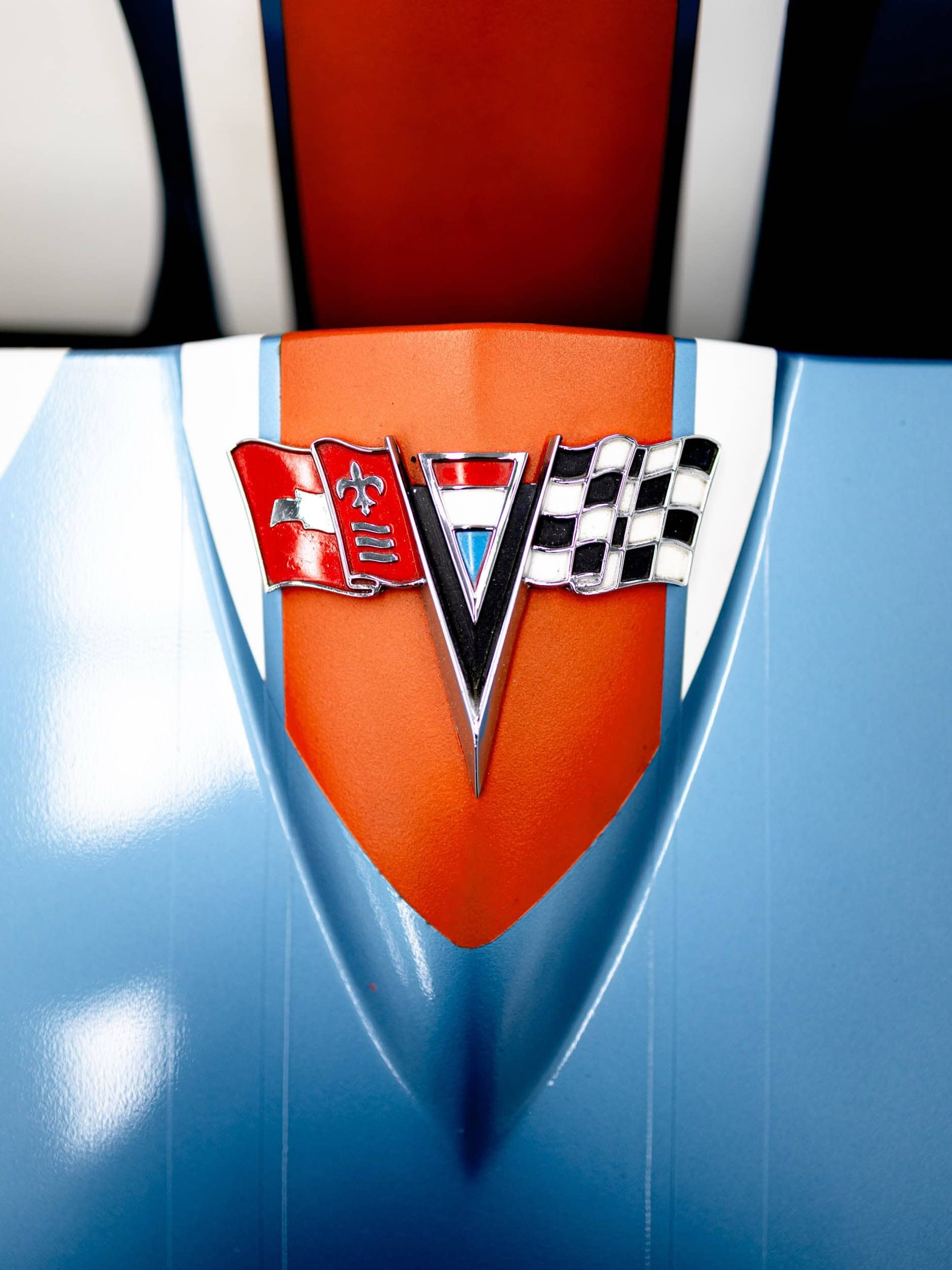

The C2 generation of the Grand Sport was a truly magnificent flash in the pan of General Motors’ history. Of the five built, two were made into open top roadsters and the other three were coupes with our example falling into the latter camp.
The Grand Sport, despite being built ready to do battle with the formidable small block Shelby Cobra — was doomed from the start. In the 1950s, auto racing had become an incredibly dangerous pursuit as safety measures failed to keep up with rapid developments in go-fast technology. In 1955 at Le Mans, disaster struck when a Mercedes 300 SLR became airborne after a collision, killing 84 and injuring over 100 people. In May 1957, after a series of NASCAR races that resulted in the deaths of spectators the Automobile Manufacture Association levied a ban on auto racing preventing all members from backing motorsport teams. The AMA was a lobby group that included nearly all American auto makers — including Chevrolet.
This move killed any hopes for a factory racing Corvette, a program still in its infancy, for the time being. Chevrolet had built and debuted the Corvette SS, also known as the XP-64 earlier in 1957. Spearheaded by Zora Arkus-Duntov, the SS was built around a tube frame chassis and dressed with magnesium body work which exaggerated the already futuristic features of the first generation Corvette. The car competed in the 12 hours of Sebring, marking the first attempt at the factory level to make the Corvette competitive in sportscar racing. The car didn’t finish the race, retiring only 23 laps in due to mechanical issues. Before the SS could get back on track, the ink had dried on the racing ban, ending the car’s competition life.
In 2018, the Corvette SS was loaned by the Indianapolis Motor Speedway Museum to Revs for a span of time and was exhibited next to our Grand Sport.


Over the next few years, Duntov ruminated in the GM offices while designing the second generation Corvette. While completing his regular engineering duties, he penned a radically different race spec of the new car under the radar of corporate with the intentions of being the fastest GT car on the grid. The body was manipulated nearly beyond recognition to help keep components cool, accommodate larger tires and evacuate air to lower drag and lift. To cut down weight Duntov put the Corvette on a strict diet, he removed two layers of the typically four layer fiberglass body, used aircraft glass for the windows, stripped down the interior and created a lighter weight version of the 350 cu in V8, pumping out nearly 500 horsepower.
When all was said and done, the Grand Sport came in 1,200 pounds lighter and 120 horsepower up on the best production spec Corvette GM offered. Duntov took three of the five Grand Sports to the 1963 12 hours of Sebring, five years after he brought the Corvette SS. Due to not meeting the 125 unit homologation requirement for the GT class, they were forced to run in the much more advanced prototype class. While the cars were completely outgunned by prototypes, Sebring proved that the Grand Sports could run keep up with Shelby’s Cobras.
The Grand Sports would finally be able to go toe to toe against the Cobras in the tropical setting of the Nassau Speed Weeks. And the Corvettes finally proved their worth as they dominated the Cobras and all other GT cars entered. Sadly, once GM and other companies caught wind of Duntov’s adventures, The Chevrolet execs pulled the plug on the program and gave the order for the five cars to be sold or crushed. Thankfully all five were sold to private owners and have survived the past 63 years.


The Grand Sport nameplate was revived by GM 33 years later, in the C4 generation as a hopped up model with a focus on handling. Serial number 001 will be present at Carlisle alongside the C2 Grand Sports.
Grand Sports have also recently found themselves in headlines of the automotive world as 1963 chassis No. 002 went to auction earlier this month, closing with a hammer price of $18.7 million.
At Revs we continue the racing legacy of the Grand Sport by keeping it on track, campaigning it at the Rolex Monterey Motorsport Reunion, Brian Redman’s Targa 66, Four Cam Jam and others. Monterey was particularly special as it gave us the opportunity to once again pit the Corvette against Cobras. We invite all in attendance to spend time with the car to see its wear from track running over the years and make conversation with the caretakers who work on it and the entire fleet at Revs.
See you at Carlisle!
