
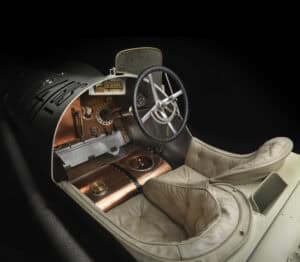
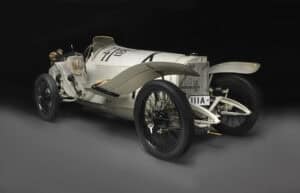
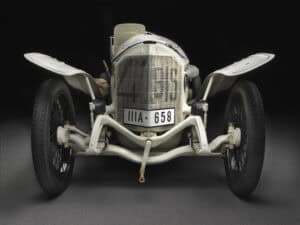
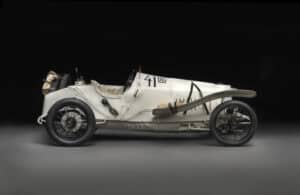
In 1909, Mercedes and other manufacturers had entered an agreement not to field factory teams. Of course, DMG’s Technical Director Paul Daimler was happy to continue building Mercedes competition cars for customers and privateers. But the 1914 French Grand Prix brought rule changes and a new challenge. Now only factory teams would be permitted to enter the race. And, for the first time, engine capacity would be limited. If Mercedes were to remain relevant, Daimler would have to reestablish a factory team and rethink the design that helped Mercedes win the 1908 French Grand Prix.
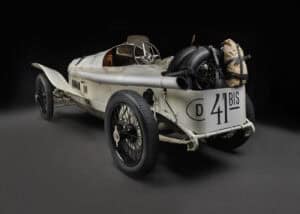
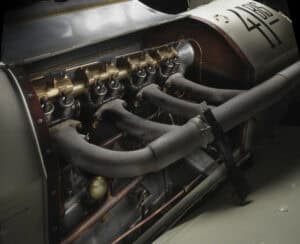
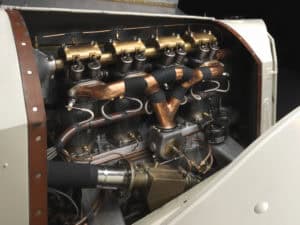
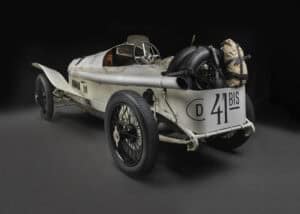
Their previous success was built on large, torquey engines. But the new rules limited capacity to 4.5 liters—compare that to the 13.5-liter engine Mercedes used at the same race in 1908! The aero division of DMG helped Daimler’s team create a new engine that would be both light and long-lasting. The result produced 105.5bhp at 3100 rpm yet weighed less than the power plants of the competition. Mercedes built six chassis for the 1914 French Grand Prix: five race entries and one spare, which is the car you see here. It was used for training and in race practice while car no. 41 received repairs, hence “41BIS,” meaning 41’s spare.
The race was held on 4 July 1914: it would be the last major race before the start of World War I. Thirteen factory teams from six countries competed fiercely for over seven hours. The odds (and spectators) were in favor of a French victory by Peugeot. Instead, Mercedes delivered a stunning upset with a 1-2-3 finish.
Mercedes’s competition cars continued to be a force in the world. The second-place chassis was sold to Ralph De Palma, who drove it to a win at the 1915 Indianapolis 500. Another Grand Prix chassis made its way to London for display; shortly thereafter, Britain declared war on Germany, and W.O. Bentley used the opportunity to have the car seized and taken apart at the Rolls-Royce factory. “It is common knowledge,” recounted Bentley, “that all Rolls-Royce aero engines built during World War I were based quite closely on this engine.”